Elton John | (Gotta Get a) Meal Ticket

“(Gotta Get a) Meal Ticket” is a track from Elton John‘s 1975 album Captain Fantastic & the Brown Dirt Cowboy.

Contributor JB writes that the tune is “from the golden days when Elton John was still an unabashed rocker. If he’d never done anything beyond playing rock piano, he still would have been inducted into the R&R Hall of Fame. There are outright mods at the beginning and end of each chorus. But the most interesting part of the song is all the keys-of-the-moment, especially the fleeting shifts from D minor to D major (and back) during the chorus.”

In an interview with Cameron Crowe, Elton said “I’ve always thought that Captain Fantastic was probably my finest album because it wasn’t commercial in any way. (It) was written from start to finish in running order, as a kind of story about coming to terms with failure—or trying desperately not to be one. We lived that story.”
Three Dog Night | Celebrate

A bonus weekend mod from our frequent contributor Paul Steckler:

“‘Celebrate’ was a hit for Three Dog Night, reaching #15 on the Billboard chart in 1970. The studio version had no modulations. But this live 1975 version features an endless series of modulations beginning at 2:36, eventually posing health risks to performers and audience alike.”

Chaka Khan | I’m Every Woman

“I’m Every Woman” was Chaka Khan‘s debut solo single in 1978 after many releases with Rufus and Chaka Khan. Produced by Arif Mardin and written by married songwriting team and recording artists Nickolas Ashford and Valerie Simpson, the single went straight to #1 on the R&B charts. The slow tempo of the tune only accentuates how it somehow successfully straddles the line between a disco feel and a heavier funk groove: a full string orchestra duels it out to a draw with an ornate slap bass line.

In 1989, a lighter, poppier version of the song saw a resurrection as a duo featuring Chaka and Whitney Houston; the track reached top 10 in the UK, Ireland, and the Netherlands.

At 2:51, Chaka alternates up and down by a minor third every four bars, over and over, all the way to the fade out.

The Cardinals | I Dreamed a Dream

Vocal quartet The Cardinals (Ben Forster, Carrie Hope Fletcher, Celinde Schoenmaker, and Ramin Karimloo) perform “I Dreamed a Dream” from Les Miserables, arranged by Nick Barstow (2019). According to Barstow’s website, “the group has a unique folk-musical theatre crossover sound, characterized by bold re-imaginings of musical theatre classics and modern pop with lush vocal harmonies.”

Starting around the 1:00 mark, this new arrangement of the Broadway classic is compelling yet harmonically relatively static, droning on the tonic of F major as the iconic melody floats above. At 2:02, the growing harmonic motion more closely resembles that of the original. From 2:24 -2:35, the arrangement piles on several pivots, landing in C major.

Madonna | Rain

A long-overdue MotD debut for Madonna: “Rain” (1993) was reviewed by Billboard‘s Larry Flick as “a gorgeous, romantic moment from the sorely underappreciated Erotica opus. A slow and seductive rhyme base surrounded by cascading, sparkling synths inspires a sweet and charming vocal.”

After the tune starts in Bb major, a thundering, sweeping synth glissando (2:37), unaccompanied by any other context, knocks us off-balance. After a bit of key-of-the-moment wandering during the bridge starting at 2:43, we transition to C major at 3:03. The 3:45 mark is a reversion to the original key, followed by another step up to C major as the tune draws to a close at 4:05.

Van Halen | Jump

A submission from MotD fan, double bassist, and multi-instrumentalist Peter McCutcheon:

“‘Jump’ was a 1984 single released by Van Halen in anticipation of their album, 1984. It reached #1 on the Billboard charts, as well as #1 in Canada and Italy. Typically, Van Halen’s style is heavy metal, with strong guitar, but this song shows that the group has some pop and synth in them too.

Primarily, the song is in the bright and energetic C major, possibly to accommodate Eddie Van Halen‘s less prodigious keyboard skills. But the eight bars of Eddie’s guitar solo suddenly shift to Db major, even beginning on a strong Bb minor chord (vi in Db Major). To return back to C Major, EVH plays a sequence in which the finger and fret pattern remain the same across five strings, beginning firmly in Db major and then ending on a high G to return to the original key (for a synth solo using only white keys). Since the progression of the guitar solo ends on the tonic rather than beginning on it, the shift to C Major is even more dramatic, by the half step motion in the bass — a musical breath of fresh air that separates Eddie’s two instrumental features.

The modulation is blink-and-you’ll-miss-it, but once you begin to notice it, it’s really cool. The modulations occur at 2:15 and 2:31.”

Ludwig van Beethoven | Sonata #14 in C Minor (“Moonlight”)

Today we are featuring the first movement (Adagio Sostenuto) of Ludwig van Beethoven‘s iconic Moonlight Sonata (#14 in C Minor, 1801). One of the composer’s more prominent students, Carl Czerny, described the movement as “a nocturnal scene, in which a mournful ghostly voice sounds from the distance.” According to biographer Alexander Thayer, the movement was immediately and overwhelmingly popular — Beethoven was said to have been irked by this development to the point that he remarked to Czerny, “Surely, I’ve written better things.”

The piece modulates many times throughout. Just for starters: C# minor at 0:00; E major at 0:40; and B minor 1:12.

Merle Hazard | (Gimme Some of That) Ol’ Atonal Music

Weekend bonus mod: Merle Hazard is billed as “America’s foremost country singer/economist.” According to his website, his songs have appeared in The Economist and the Financial Times; on the PBS NewsHour and on radio; and in college classrooms.

Hazard explains: “I love Tom Lehrer and Cole Porter. In some ways, they are my natural musical home, more than country. I listened to a lot of Tom Lehrer and Top 40 pop, growing up. The name ‘Merle Hazard’ is first and foremost a pun on the economic concept of ‘moral hazard.’ It is also a tip of the cowboy hat to the Merles who preceded, particularly Merle Travis and the late, great Merle Haggard.”

“(Gimme Some of That) Ol’ Atonal Music” (2019) modulates at 1:36 and 2:22.

Kenny Loggins | Return to Pooh Corner

Here’s another modulation from frequent contributor JB: the live version of Kenny Loggins‘ “Return to Pooh Corner” from Outside: From the Redwoods, recorded in 1993 in Santa Cruz Shakespeare‘s Festival Glen.

“The track has a nifty modulation into the bridge at 2:09, and then another rather haunting mod at 3:10. The backing vox on this song are pretty sweet for a live performance, especially since they’re done by instrumentalists, and not dedicated singers.”

Jimmy Ruffin | What Becomes of the Broken Hearted

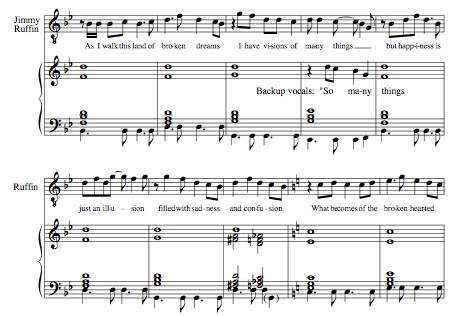
Today we’re focusing on “What Becomes of the Broken Hearted” (1966) by Jimmy Ruffin. The website Overthinking It has a great writeup on the tune, which we won’t even try to improve on:

The tune “goes from Bb major to C major when it moves from the verse to the chorus, which is as cheesy a modulation as you could hope for. But damn if the songwriters don’t work for it.

The basic structure of the verse is ingenious enough to begin with: I->iii->vi->IV->V->I (notice how much time it spends hanging out on the minor chords of iii and vi. This is one of the saddest songs ever written in a major key.) As it moves towards the chorus, the pattern changes ever so slightly. After landing on vi, instead of going down a third to the subdominant, the harmony just reverses course and moves back to iii. This is a totally orthodox harmonic move (root motion by a fifth is pretty much always allowed) but it destabilizes the harmony enough for the new key in the chorus to seem like an arrival, and not merely an extravagance.”

from http://overthinkingit.com

In addition, quite a few of the chords have inverted voicings, only adding to the ambiguity. The track went top 10 in the US, UK, and France and has since been covered by a range of artists including The Supremes, Joan Osborne, Boy George, and Joe Cocker.