NSFW: Lizzo‘s 2019 track “Lingerie” (from the Cuz I Love You album) debuted at #6 on the Billboard 200. The track simmers at an almost impossibly slow, insistent tempo but still somehow manages a behind-the-beat delivery. From AllMusic‘s review: “she continues to embrace her gospel roots and the full power of her voice. It’s a journey she began on (previous albums), which feel like dress rehearsals for what she unleashes…”
“Spirit” by Beyoncé, featured in the 2019 remake of The Lion Kingmovie, was reviewed by Slate.com‘s Carl Wilson as an “award-baiting piece of Hollywood-goes-gospel.” After an intro built around choristers singing in Swahili, Beyonce shows off not only her trademark fluid melisma, but also the far edges of her range, both high and low. The half-step modulation is at 3:30.
The tune is known for its wide-ranging harmonies, which transiently meander quite far from the original key during most of the tune (other than the beginning and ending bars of the form). But this particular version by The Artie Shaw Orchestra (Helen Forrest, vocalist) also features several outright key changes. Starting in A minor, the key shifts to D minor as the vocal melody leads us through the form (1:28), the final instrumental section starts in Bb minor (2:45) and ends in Db major.
“I’m Every Woman” was Chaka Khan‘s debut solo single in 1978 after many releases with Rufus and Chaka Khan. Produced by Arif Mardin and written by married songwriting team and recording artists Nickolas Ashford and Valerie Simpson, the single went straight to #1 on the R&B charts. The slow tempo of the tune only accentuates how it somehow successfully straddles the line between a disco feel and a heavier funk groove: a full string orchestra duels it out to a draw with an ornate slap bass line.
In 1989, a lighter, poppier version of the song saw a resurrection as a duo featuring Chaka and Whitney Houston; the track reached top 10 in the UK, Ireland, and the Netherlands.
At 2:51, Chaka alternates up and down by a minor third every four bars, over and over, all the way to the fade out.
Starting around the 1:00 mark, this new arrangement of the Broadway classic is compelling yet harmonically relatively static, droning on the tonic of F major as the iconic melody floats above. At 2:02, the growing harmonic motion more closely resembles that of the original. From 2:24 -2:35, the arrangement piles on several pivots, landing in C major.
A long-overdue MotD debut for Madonna: “Rain” (1993) was reviewed by Billboard‘s Larry Flick as “a gorgeous, romantic moment from the sorely underappreciated Erotica opus. A slow and seductive rhyme base surrounded by cascading, sparkling synths inspires a sweet and charming vocal.”
After the tune starts in Bb major, a thundering, sweeping synth glissando (2:37), unaccompanied by any other context, knocks us off-balance. After a bit of key-of-the-moment wandering during the bridge starting at 2:43, we transition to C major at 3:03. The 3:45 mark is a reversion to the original key, followed by another step up to C major as the tune draws to a close at 4:05.
Today we are featuring the first movement (Adagio Sostenuto) of Ludwig van Beethoven‘s iconic Moonlight Sonata (#14 in C Minor, 1801). One of the composer’s more prominent students, Carl Czerny, described the movement as “a nocturnal scene, in which a mournful ghostly voice sounds from the distance.” According to biographer Alexander Thayer, the movement was immediately and overwhelmingly popular — Beethoven was said to have been irked by this development to the point that he remarked to Czerny, “Surely, I’ve written better things.”
The piece modulates many times throughout. Just for starters: C# minor at 0:00; E major at 0:40; and B minor 1:12.
Weekend bonus mod: Merle Hazard is billed as “America’s foremost country singer/economist.” According to his website, his songs have appeared in The Economist and the Financial Times; on the PBS NewsHour and on radio; and in college classrooms.
Hazard explains: “I love Tom Lehrer and Cole Porter. In some ways, they are my natural musical home, more than country. I listened to a lot of Tom Lehrer and Top 40 pop, growing up. The name ‘Merle Hazard’ is first and foremost a pun on the economic concept of ‘moral hazard.’ It is also a tip of the cowboy hat to the Merles who preceded, particularly Merle Travis and the late, great Merle Haggard.”
“(Gimme Some of That) Ol’ Atonal Music” (2019) modulates at 1:36 and 2:22.
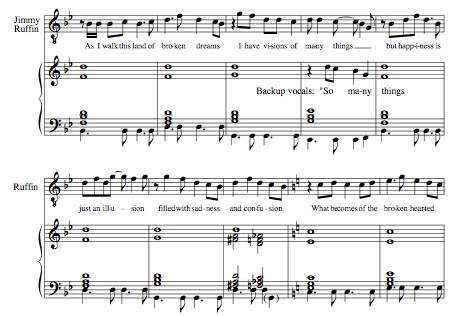
Today we’re focusing on “What Becomes of the Broken Hearted” (1966) by Jimmy Ruffin. The website Overthinking It has a great writeup on the tune, which we won’t even try to improve on:
The tune “goes from Bb major to C major when it moves from the verse to the chorus, which is as cheesy a modulation as you could hope for. But damn if the songwriters don’t work for it.
The basic structure of the verse is ingenious enough to begin with: I->iii->vi->IV->V->I (notice how much time it spends hanging out on the minor chords of iii and vi. This is one of the saddest songs ever written in a major key.) As it moves towards the chorus, the pattern changes ever so slightly. After landing on vi, instead of going down a third to the subdominant, the harmony just reverses course and moves back to iii. This is a totally orthodox harmonic move (root motion by a fifth is pretty much always allowed) but it destabilizes the harmony enough for the new key in the chorus to seem like an arrival, and not merely an extravagance.”
In addition, quite a few of the chords have inverted voicings, only adding to the ambiguity. The track went top 10 in the US, UK, and France and has since been covered by a range of artists including The Supremes, Joan Osborne, Boy George, and Joe Cocker.
AllMusic reviewed “Breaking Up Is Hard to Do” by songwriter and performer Neil Sedaka
as “two minutes and sixteen seconds of pure pop magic.” The track hit
#1 on the Billboard Hot 100 in August 1962 and #1 on the Hot R&B
Sides chart. A worldwide hit, the single reached #7 in the UK. The song
was translated into quite a few foreign languages; the Italian version
was called “Tu non lo sai” (“You Don’t Know”), performed by Sedaka
himself. Backing vocals were by a girl group called The Cookies.
Although the form is not a standard one, it’s at least clear that at 0:49 – 1:06 and 1:22 – 1:39, the tune pivots away from its primary key of C major.

 modulationoftheday.home.blog