Here’s another modulation from frequent contributor JB: the live version of Kenny Loggins‘ “Return to Pooh Corner” from Outside: From the Redwoods, recorded in 1993 in Santa Cruz Shakespeare‘s Festival Glen.
“The track has a nifty modulation into the bridge at 2:09, and then another rather haunting mod at 3:10. The backing vox on this song are pretty sweet for a live performance, especially since they’re done by instrumentalists, and not dedicated singers.”
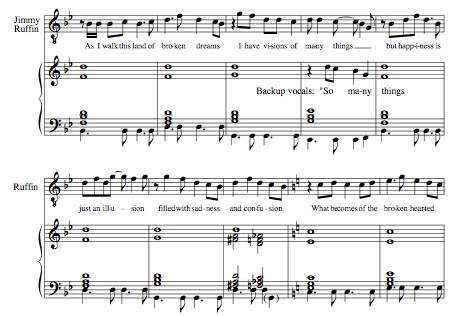
Today we’re focusing on “What Becomes of the Broken Hearted” (1966) by Jimmy Ruffin. The website Overthinking It has a great writeup on the tune, which we won’t even try to improve on:
The tune “goes from Bb major to C major when it moves from the verse to the chorus, which is as cheesy a modulation as you could hope for. But damn if the songwriters don’t work for it.
The basic structure of the verse is ingenious enough to begin with: I->iii->vi->IV->V->I (notice how much time it spends hanging out on the minor chords of iii and vi. This is one of the saddest songs ever written in a major key.) As it moves towards the chorus, the pattern changes ever so slightly. After landing on vi, instead of going down a third to the subdominant, the harmony just reverses course and moves back to iii. This is a totally orthodox harmonic move (root motion by a fifth is pretty much always allowed) but it destabilizes the harmony enough for the new key in the chorus to seem like an arrival, and not merely an extravagance.”
In addition, quite a few of the chords have inverted voicings, only adding to the ambiguity. The track went top 10 in the US, UK, and France and has since been covered by a range of artists including The Supremes, Joan Osborne, Boy George, and Joe Cocker.
AllMusic reviewed “Breaking Up Is Hard to Do” by songwriter and performer Neil Sedaka
as “two minutes and sixteen seconds of pure pop magic.” The track hit
#1 on the Billboard Hot 100 in August 1962 and #1 on the Hot R&B
Sides chart. A worldwide hit, the single reached #7 in the UK. The song
was translated into quite a few foreign languages; the Italian version
was called “Tu non lo sai” (“You Don’t Know”), performed by Sedaka
himself. Backing vocals were by a girl group called The Cookies.
Although the form is not a standard one, it’s at least clear that at 0:49 – 1:06 and 1:22 – 1:39, the tune pivots away from its primary key of C major.
From live theatre critic Michael J. Curtiss comes this knockout crowd-sourced 2019 cover of “You Will Be Found” from Dear Evan Hansen. Boys’ choruses from Welsh towns and cities large and small were brought together through Only Boys Aloud, the boys’ division of The Aloud Charity. Aloud’s mission is “to engage young people across Wales with the power of choral singing.”
The modulation is at 2:29 after a gorgeous transition passage starting at 2:18.
According to the Green Bay Press-Gazette, “‘Jackie Blue’ has a certain structure that happens to sound good on a car radio.” The tune was the first of the Ozark Mountain Daredevils‘ singles to feature drummer Larry Lee on lead vocal. TheMontreal Gazette, assuming that the track was sung by a woman, scolded the band for producing a track that sounded like “an outrageous knockoff of Fleetwood Mac’s sound, down to the female lead.” The track hit #3 on the Billboard Hot 100 in May 1975.
The verses are in Eb minor, transitioning to G majvor for the choruses (0:28) and back to Eb for the next verse (0:46), etc.
Duke Ellington’s ballad “In a Sentimental Mood” (1935) was recorded several times by its composer, including this version with saxophonist John Coltrane from 1963. The tune starts in Bb minor and ends in Db major, with a middle eight in A major (1:10 – 1:35). The tune saw prominent covers by Art Tatum, Sonny Rollins, and McCoy Tyner, among others.
Of the recording session, Coltrane said: “(Duke) has set standards I haven’t caught up with yet. I would have liked to have worked over all those numbers again, but then I guess the performances wouldn’t have had the same spontaneity. And they mightn’t have been any better!”
From MotD fan Jonathan Jharms Harms comes a beautifully detailed breakdown of an all-time best pop modulation we featured in 2017.
“If you’re like me, you’ve found yourself on a night on the town with friends, singing along to the The Doobie Brothers‘ 1979 classic ‘What a Fool Believes’ – but when the chorus comes, no one can find the right note. Is it the alcohol? Is it your memory? Nope – it’s modulation! Modulation written so smoothly you never noticed.
Songwriter Michael McDonald, after emphasizing the IV chord in every phrase of the song, makes the most soulful (and innocuous) of changes in the chorus – beginning the chorus a minor iv instead of a major IV. But wait – no – that was a pivot to a new key! Before you know it, we transition from C# major to E major – a strange jump to a very unrelated key, but without you ever noticing. Only the most observant will notice the A naturals turning into A sharps as the chorus fades into Verse 3, back to C# major.
Unlike other modulations that are all about calling attention to themselves or ‘raising the stakes,’ this one simply takes you on a ride. Maybe that’s why we’re still singing (or failing to sing) this amazing song, 40 years later.”
From Kent P., a MotD fan who’s contributed before, comes the show-stopping production number “Show Off” from The Drowsy Chaperone, which was produced on Broadway in 2006.
Kent reports: “A hilarious number that makes fun of every old musical cliché by doing them. And of course, one such cliché is the key change! Here’s a video (with good audio quality but less good video quality) from the Tony Awards, with Sutton Foster performing the song. There’s a long intro to the actual song, which doesn’t start until 1:35; after many other key changes, the main modulation is around 4:35. It is probably the most self-referential modulation ever!”
Elvis Costello‘s 1980’s atmospheric “Clubland,” produced by Nick Lowe, is another contribution from prolific mod correspondent JB. The track features “quasi-latin” piano by Steve Nieve, according to American Songwriter, that’s “all over the place, propelling the song in different directions, without ever getting in the way of the tune.”
Starting in B minor, there’s a switch to B major for the chorus at 0:35, then back to minor for verse 2 at 0:51. At 1:37, the bridge begins, combining alternating B major and B minor within the vocal line from 1:52 – 2:07. Many thanks to blue-ribbon mod contributor JB for this tune!
The frenetic pace of “Overtime” (2017) finds the entire band in an almost impossible flow state, led by drummer/keyboardist/composer Louis Cole and Genevieve Artadi, vocalist. After the tune starts in F# minor, the main groove hits at 0:33. A modulation to G# minor (0:50) is introduced by a 2-bar break, sparely punctuated by a few huge syncopated kicks. At 1:18, the tune reverts to F# minor and the cycle repeats.

 modulationoftheday.home.blog