First recorded in 1956 by vocalist Johnny Mathis and bandleader Roy Conniff, “When Sunny Gets Blue” quickly became a jazz standard. This version was performed by piano legend McCoy Tyner and his trio in 1962, after his stint as sideman for John Coltrane. Tyner, a 4-time Grammy winner, was named a National Endowment for the Arts Jazz Master in 2002; after 80 albums, he still continues to record.
The 32-bar form modulates at the start of the middle 8 (heard for the first time at 1:04), modulates halfway through the middle 8 at 1:20, then back to the original key at 1:36. The form starts again at 2:07, as we hear a solo from Tyner.
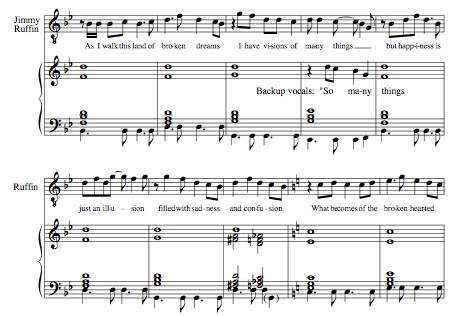
Today we’re focusing on “What Becomes of the Broken Hearted” (1966) by Jimmy Ruffin. The website Overthinking It has a great writeup on the tune, which we won’t even try to improve on:
The tune “goes from Bb major to C major when it moves from the verse to the chorus, which is as cheesy a modulation as you could hope for. But damn if the songwriters don’t work for it.
The basic structure of the verse is ingenious enough to begin with: I->iii->vi->IV->V->I (notice how much time it spends hanging out on the minor chords of iii and vi. This is one of the saddest songs ever written in a major key.) As it moves towards the chorus, the pattern changes ever so slightly. After landing on vi, instead of going down a third to the subdominant, the harmony just reverses course and moves back to iii. This is a totally orthodox harmonic move (root motion by a fifth is pretty much always allowed) but it destabilizes the harmony enough for the new key in the chorus to seem like an arrival, and not merely an extravagance.”
In addition, quite a few of the chords have inverted voicings, only adding to the ambiguity. The track went top 10 in the US, UK, and France and has since been covered by a range of artists including The Supremes, Joan Osborne, Boy George, and Joe Cocker.
AllMusic reviewed “Breaking Up Is Hard to Do” by songwriter and performer Neil Sedaka
as “two minutes and sixteen seconds of pure pop magic.” The track hit
#1 on the Billboard Hot 100 in August 1962 and #1 on the Hot R&B
Sides chart. A worldwide hit, the single reached #7 in the UK. The song
was translated into quite a few foreign languages; the Italian version
was called “Tu non lo sai” (“You Don’t Know”), performed by Sedaka
himself. Backing vocals were by a girl group called The Cookies.
Although the form is not a standard one, it’s at least clear that at 0:49 – 1:06 and 1:22 – 1:39, the tune pivots away from its primary key of C major.
Duke Ellington’s ballad “In a Sentimental Mood” (1935) was recorded several times by its composer, including this version with saxophonist John Coltrane from 1963. The tune starts in Bb minor and ends in Db major, with a middle eight in A major (1:10 – 1:35). The tune saw prominent covers by Art Tatum, Sonny Rollins, and McCoy Tyner, among others.
Of the recording session, Coltrane said: “(Duke) has set standards I haven’t caught up with yet. I would have liked to have worked over all those numbers again, but then I guess the performances wouldn’t have had the same spontaneity. And they mightn’t have been any better!”
Ever pushing the envelope, composer/pianist Burt Bacharach wasn’t content to throw a routine modulation into the 1964 ballad “A House Is Not a Home.” Instead, the tune’s bridge starts in the original key at 2:40, waits to change key until after the bridge has started at 2:53, and then reverts to the original key at 3:21.
While it was only a modest hit (#71) on its initial release, the song has spawned dozens of covers over the years, from Cher to Aretha Franklin to Sonny Rollins. The late Luther Vandross, a legendary 8-time Grammy winning vocalist, clearly made the tune his own. But the song’s original vocalist was frequent Bacharach muse Dionne Warwick.
Singer/songwriter Jacques Brel produced music which AllMusic calls “literate, thoughtful, and theatrical songs that brought him a large, devoted following in France. His audience eventually extended internationally, making him a major influence on English-speaking writers and performers including Leonard Cohen and David Bowie.” After releasing many albums, often built around a contemporary chanson style, Brel produced a musical revue, Jacques Brel is Alive and Well and Living in Paris, off-Broadway at NYC’s Village Gate in 1968. The show has since enjoyed dozens of well-received revivals.
The show’s 26 story songs included a restless, ever-building waltz, “Marieke” — as much an ode to his Belgian homeland as to his beloved. Modulation at 2:23.
The Four Freshmen, formed in 1948, released “Shangrila” in 1962. Known as a vocal band because all of the group’s members self-accompanied the quartet’s vocals with their own instrumental playing, the Freshmen featured jazz-infused open harmonies. According to his biographer, a young Brian Wilson of The Beach Boys found the 1950s output of the Freshmen to be an inspiration: “It brings a feeling of love inside me…that feeling of harmony.” The modulation is at 1:39.
“I’ve Been Everywhere” is a song which was originally made popular upon its initial Australian releases (with Aussie place names) in 1959 and 1962. In 1962, the song was also a #1 US country hit by Hank Snow — with multiple half-step modulations at 1:12, 1:37, and 2:03.
More recently, Johnny Cash had another country hit with the tune in 1996, with several TV ad placements; the video is posted second. However, Cash’s version has no modulations.
“Who can turn a dolorous Mexican popular song into a surf guitar classic? Why, The Ventures, of course. Their 1960 version of “Perfidia” (Spanish for “perfidy”, meaning faithlessness, treachery or betrayal) changes key at 1:07.”
Other than the Ventures’ version, which hit #18 on the pop charts, the tune has been covered by Desi Arnaz, Nat King Cole, and Linda Ronstadt, among many others.
Chalk up another mod for frequent contributor JB: According to AllMusic, the Nice “bridged the gap between mid-’60s psychedelic pop and 70s art rock, laying the groundwork for the entire progressive rock explosion in the process. It was with the Nice that Keith Emerson began his transformation from an unknown musician into an international rock star with Emerson, Lake & Palmer.” Over time, the band pulled excerpts from an eclectic range of composers including Sibelius, Janacek, Brubeck, Tchaikovsky, Bernstein, and more, including this 1969 tune featuring a J. S. Bach melody.
At 2:28, there’s a short bridge based on a quote from the Brandenburg Concerto #3; at 2:46, after a pause, the tune modulates up a whole step.

 modulationoftheday.home.blog