“I Wanna Be The Only One” topped the UK Singles charts in 1997, and was the British R&B girl group Eternal’s biggest hit. Three key changes — 2:25, 2:44, and 3:04.
Tag: r&b
Mama’s Gun | You Are the Music
From long-time neo-soul/r&b aficionado and first-time MotD contributor Aaron L. comes this effervescent, unapologetic love song, “You Are the Music,” from London r&b/neo-soul/pop quintet Mama’s Gun.
The album which featured today’s track, Routes to Riches (2009), was reviewed by Uncut magazine as “a masterclass in blue-eyed bubblegum soul, as heart-warmingly catchy as anything from Stevie Wonder’s ’70s purple patch.” The band has opened for fellow Brits, pop/funk legends Level 42, and American neo-soul artist/producer Raphael Saadiq.
Starting in A minor for the verse, the chorus transitions to compelling A major(ish) mix, then reverting to minor for the next verse. At 2:18, a breakdown/bridge pushes us into D minor, leading to a big modulation into Bb major(ish) for the remaining choruses.
George Benson | On Broadway
Another mod from frequent contributor JB: “On Broadway” was first a hit for The Drifters in 1963. In 1978, guitarist/vocalist George Benson covered the tune, which is part of his smash hit album Weekend in LA. Benson’s version became a sustained adult contemporary and smooth jazz radio mainstay and won a Grammy for Best R&B Vocal Performance.
The several modulations couldn’t be clearer (there’s a mini-“intro” after each one before the lyrics of the next verse start!), so we won’t timeslate them.
Kool + the Gang | September Love
Funk/pop superstars Kool and the Gang, best known for 1980’s uptempo mega-hit “Celebrate,” took a decidedly mellower turn in the early 80s. According to AllMusic, the band “left the fast lanes of funk for the smoother ride of the adult-oriented R&B expressway.” The 1983 album In the Heart produced a lead single, “Joanna,” which hit #2 (pop) in the US, #2 (pop) in the UK, and #1 on the US R&B chart.
No stranger to a broad harmonic vocabulary, the band outdid itself on the mod scale with the ballad “September Love,” a non-single track. Modulations begin with an almost jarring early shift as the first verse starts at 0:21, followed by more key changes at 1:15, 1:49, 2:43, 3:18, and 3:59.
Lizzo | Lingerie
NSFW: Lizzo‘s 2019 track “Lingerie” (from the Cuz I Love You album) debuted at #6 on the Billboard 200. The track simmers at an almost impossibly slow, insistent tempo but still somehow manages a behind-the-beat delivery. From AllMusic‘s review: “she continues to embrace her gospel roots and the full power of her voice. It’s a journey she began on (previous albums), which feel like dress rehearsals for what she unleashes…”
Half-step modulations at 1:25 and 2:26.
Chaka Khan | I’m Every Woman
“I’m Every Woman” was Chaka Khan‘s debut solo single in 1978 after many releases with Rufus and Chaka Khan. Produced by Arif Mardin and written by married songwriting team and recording artists Nickolas Ashford and Valerie Simpson, the single went straight to #1 on the R&B charts. The slow tempo of the tune only accentuates how it somehow successfully straddles the line between a disco feel and a heavier funk groove: a full string orchestra duels it out to a draw with an ornate slap bass line.
In 1989, a lighter, poppier version of the song saw a resurrection as a duo featuring Chaka and Whitney Houston; the track reached top 10 in the UK, Ireland, and the Netherlands.
At 2:51, Chaka alternates up and down by a minor third every four bars, over and over, all the way to the fade out.
Jimmy Ruffin | What Becomes of the Broken Hearted
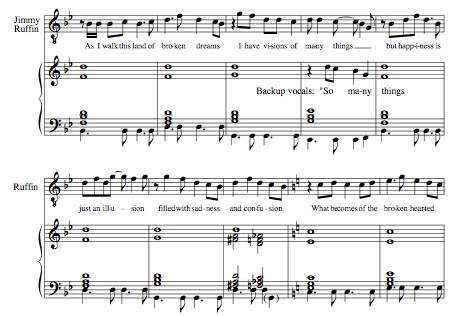
Today we’re focusing on “What Becomes of the Broken Hearted” (1966) by Jimmy Ruffin. The website Overthinking It has a great writeup on the tune, which we won’t even try to improve on:
The tune “goes from Bb major to C major when it moves from the verse to the chorus, which is as cheesy a modulation as you could hope for. But damn if the songwriters don’t work for it.
The basic structure of the verse is ingenious enough to begin with: I->iii->vi->IV->V->I (notice how much time it spends hanging out on the minor chords of iii and vi. This is one of the saddest songs ever written in a major key.) As it moves towards the chorus, the pattern changes ever so slightly. After landing on vi, instead of going down a third to the subdominant, the harmony just reverses course and moves back to iii. This is a totally orthodox harmonic move (root motion by a fifth is pretty much always allowed) but it destabilizes the harmony enough for the new key in the chorus to seem like an arrival, and not merely an extravagance.”

In addition, quite a few of the chords have inverted voicings, only adding to the ambiguity. The track went top 10 in the US, UK, and France and has since been covered by a range of artists including The Supremes, Joan Osborne, Boy George, and Joe Cocker.
Luther Vandross | A House Is Not a Home
Ever pushing the envelope, composer/pianist Burt Bacharach wasn’t content to throw a routine modulation into the 1964 ballad “A House Is Not a Home.” Instead, the tune’s bridge starts in the original key at 2:40, waits to change key until after the bridge has started at 2:53, and then reverts to the original key at 3:21.
While it was only a modest hit (#71) on its initial release, the song has spawned dozens of covers over the years, from Cher to Aretha Franklin to Sonny Rollins. The late Luther Vandross, a legendary 8-time Grammy winning vocalist, clearly made the tune his own. But the song’s original vocalist was frequent Bacharach muse Dionne Warwick.
Stevie Wonder | Sweetest Somebody I Know
Stevie Wonder‘s “Sweetest Somebody I Know” is from his 2005 album A Time to Love. From AllMusic’s album review: “Many of these songs, save for their warm and polished digital production values, could have easily found a home in Talking Book, Music of My Mind, or any of the other albums for which Wonder will forever be praised. In an age when the majority of R&B is about money, drugs, infidelity, or getting it on, Wonder‘s lyrics (especially during the love songs) recall the simplicity and innocence of early Motown without sounding trite.” The key change is at 3:01.
Average White Band | Schoolboy Crush
Chalk up another mod contribution for JB: “Schoolboy Crush” was a 1975 hit single for Scottish funk stalwarts Average White Band, reaching top 30 on the US pop and R&B charts. The album which featured the track, Cut the Cake, gained ongoing fame when it scored positions of #4 (Pop) and #1 (R&B) on the year-end album charts. The tune has enjoyed a renewed lease on life through extensive sampling by hiphop artists from TLC to Floetry to Eric b and Rakim to NAS.
Starting in E minor, the tune has a tritone shift to Bb minor at 1:17, then G minor at 1:40 and back to E minor.